Fiery horses and other bees
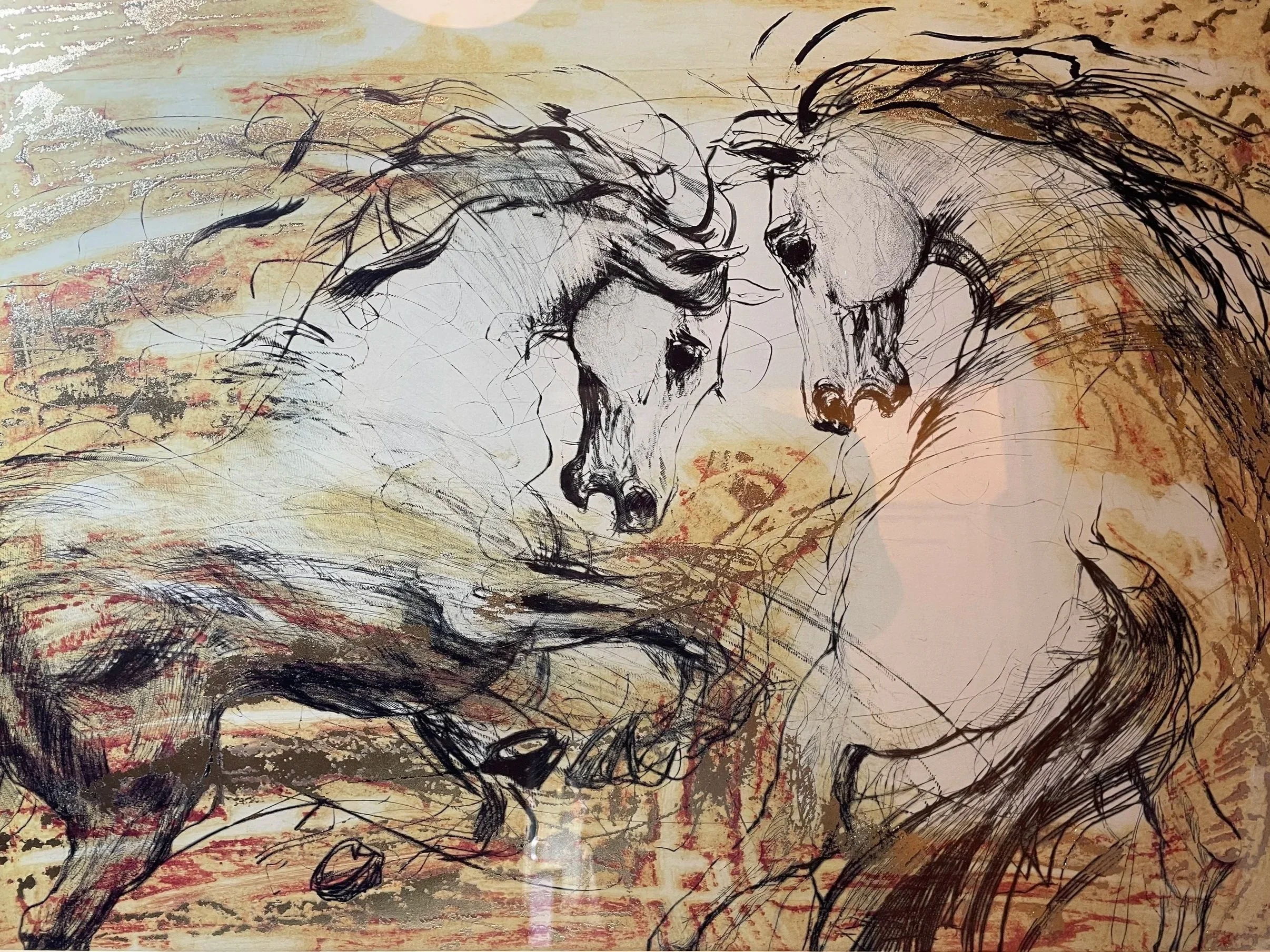
2026 Year of the Fire Horse. Photograph by Sarah Keen - from a private collection
Happy New Year and Welcome to 2026.
I found this beautiful oil painting in a car boot fair many years ago and happy to share these golden horses of the sun with you. ~Blessings
I thought for the first blog of the year I would share our life with bees over 2025. These delicate, fierce and fiery insects that have captivated our hearts here in Enchanted England.
This time last year our hearts were broken when we realised a terrible radio silence had fallen on the beehive. However hard I pressed my ear to the side I could hear nothing apart from the hollowing echoes in my ears. Like listening to an empty shell. Don’t despair counselled our bee mentors they may be ok. Deep down we knew they weren’t and our fears were confirmed when we were able to open up the hive and find a small huddle of dead bees, frames full of honey and the rest of the hive gone.
What had gone wrong? They had not starved to death clearly - but why had the full supplies been left abandoned? Our best guess was we had not treated the colony enough for varroa. Varroa is a hideous parasite that preys on both the adult bee and the larvae in the cell. During the winter the queen stops laying but the varroa mite still predates the remaining adult bees. Once weakened they become unable to find their food stores and the strongest of them, sometimes with the queen, abandon the site for pastures new. This has the unfortunate effect of further spreading the parasite.
Grim. I cursed watching the online videos that argued for an organic approach the mite, that advocated herd immunity and a magical resistance to this predator. I remembered by great-grandmother telling me about children arriving with nits and lice at their rudimentary primary schools. Were they allowed to remain infested? Reader they were not. Children can no more clear their heads of parasites that bees can. Treatment is required.
Armed with a take no prisoners attitude to varroa pest we ordered a new colony of bees to arrive in the spring. We cleared out the hive using flames to scorch down the sides and destroyed the frames. It was difficult to throw away the honey but all had to go. We then took out a spare hive that had not been used in years and so prepared for our new queen.
If you remember the spring of 2025 in England, it was beautiful. By the time our newbies arrived the apple and fruit trees were full of blossom the hive shimmered in a haze of pollen. The bees hummed with joy. They were peaceful, calm and thriving. A great happiness! As we were not taking honey this year, we treated regularly with Oxalic Acid to keep the mites at bay.
One day in July I visited the bees where, like the carol, all was calm, all was bright. I pottered off to inspect the pond that was full of dragonflies, newts and little bees visiting to drink, perching on lily pads, sipping the water. Around me a profusion of wild flowers nodded their heads across a range of grasses.
On turning round, however, I saw the sky was boiling with a hectic energy. A dark, shape-shifting ball of furious noise appeared from a crack in the sky and tore through the garden toward the hive. A swarm! I ran towards it - checking on our bees as I did so. They were still drifting in a peaceful fashion in and out, ferrying parcels of pollen into the colony's dark interior. I called my husband and we gazed at the swarm as it circled and then settled into the apple tree. It too calmed in the sunshine, now it looked like the strangest of Cheshire cats, a deep purring sound came from its centre. Alas the swarm was too high for us to safely collect although we have been looking for one for years to add to our hive numbers.
We fetched another hive and put it at the base of the tree in order to temp the new queen in . Sadly, after an hour they flew away for another beekeeper to collect in the next village. We forgot the hive and returned to the house feeling disappointed.
A few weeks later I remembered the hive and decided it should be put away. I lifted up its lid and there was the most beautiful nest. It was composed of hay and feathers and the most tremendous heat emanated from it. Cautiously I investigated further and found it contained several baby field mouse babies. They were new-born and hairless. Deep in the frames I spotted their mother. Her back legs were braced against the wood so that she was almost upright. She raised her head towards me and lifted her front paws almost to a prayer position. So we looked at each other. Her babies were safe from me. She was too far from the house to cause us harm and the field was regularly predated by owls and sparrowhawks. I gently replaced the lid and walked away.
Over the next few days, I watched her babies grow, become clad in fur until the time came when all had left. Only the wondrously constructed nest remained. The hive was silent but this time the silence spoke of continuing life.
The good news that, as I write in January, there is a steadfast humming from the beehive. We keep all our fingers crossed that despite the warm, wet winter the fiery little bees have the strength to make it through to spring.
All best wishes for 2026