The Hedge King
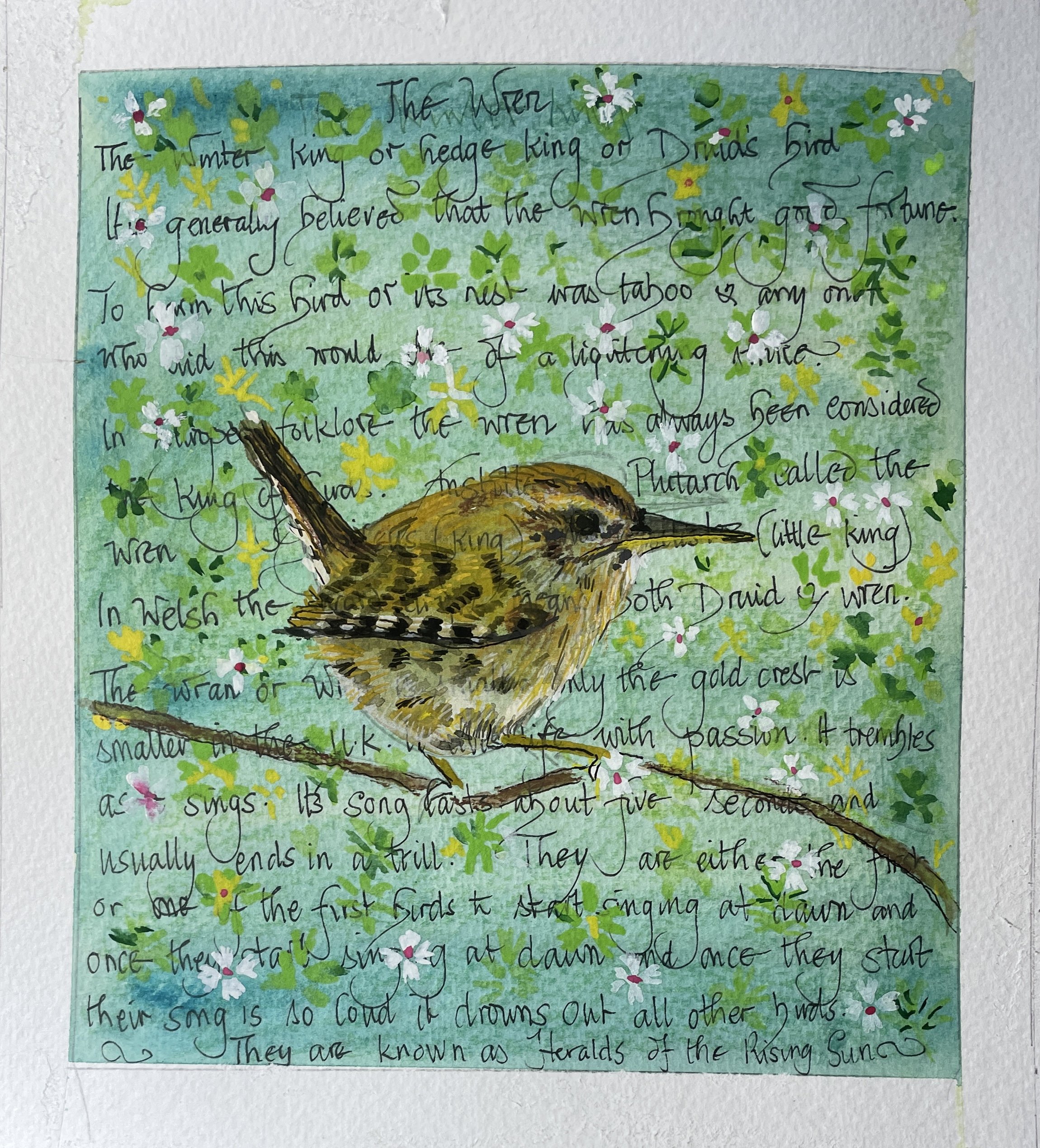
The Hedge King - Watercolour,Ink, Gouache Sarah Keen
Despite the fierce heat, the garden has been filled with birds - seemingly rejoicing. The old Willow Tree hosts parties of chaffinches and a thrush leaves a trail of empty snail shells across the patio. Yesterday, walking in the evening I heard the most terrific shouting from our hawthorn hedge. It was an angry, demanding note and some branches were shaking in a small fury. I peered in but saw nothing and then wriggled into the hedge itself - a task made easier as deer use it to access our field.
Once inside the shrill continued and as my eyes adjusted to the shadows I made out a newly fledged wren. It shouted like a teenager at its parents for food. They were studiously avoiding their child. Flitting away through densely shadowed leaves. they clearly thought it was time for their offspring to fend for itself.
None of them were greatly troubled by my presence and this is my experience of wrens. Tiny in size - about 5 cms - they are nevertheless confident birds. They swagger through the trees and branches - singing their trilling song at full volume. The sound they make is incredible. So if you don’t see one - you will hear them - fearless and swaggering. A sign that your garden is in rude health.
I painted this portrait partly from memory and partly from photo references - but here he is roughly as I remember him. I love combining text with my drawings now. I am also experimenting with watercolour glazes. This painting started on a lime green wash, text, blue glaze and then watercolours with ink and gouache
The wren is an important bird in Celtic and Christian religion - here are just some of its stories.
In European folklore, the wren is the king of the birds, according to a fable attributed to Aesop by Plutarch, when the eagle and the wren strove to fly the highest, the wren rested on the eagle's back, and when the eagle tired, the wren flew out above him. Thus, Plutarch implied, the wren proved that cleverness is better than strength. The wren's majesty is recognised in such stories as the Grimm Brothers'The Willow-Wren and the Bear Aristotle and Plutarch called the wren basileus (king) and basiliskos (little king). In German, the wren is called Zaunkönig (king of the fence). An old German name was "Schneekönig" (snow king), and in Dutch, it is "winterkoning" (winter king), which all refer to king. In Japan, the wren is labelled king of the winds, and the myth of The Wren Among the Hawks sees the wren successfully hunt a boar that the hawks could not, by flying into its ear and driving it mad
It was a sacred bird to the Druids, who considered it "king of all birds", and used its musical notes for divination.The shape-shifting Fairy Queen took the form of a wren, known as "Jenny Wren" in nursery rhymes. A wren's feather was thought to be a charm against disaster or drowning.
With thanks to Wikipedia for this information.
Hoping you are keeping cool and carrying on
x