Fish 4 Tosca
Glyndebourne’s First Edition Tosca 10 August 2026
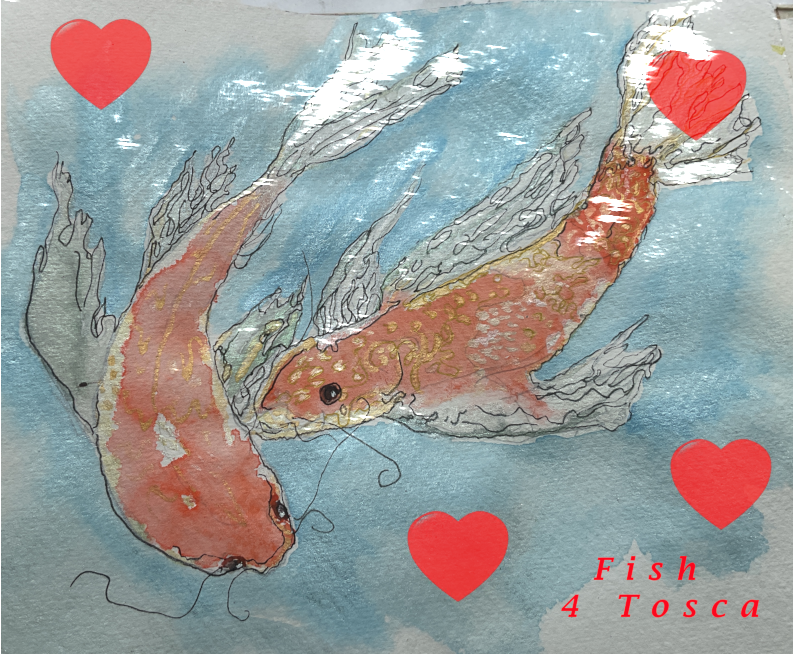
Well dear Glyndebourne we fell out over L’Orfeo good and proper. So first things first. Thank you for cleaning the Mildmay fountain and ensuring the fish were no longer swimming in slime. Great to see these beautiful golden fish are now enjoying clean water once more..
Oh Tosca! This Opera, is a lyrical exploration of the truthfulness of love against falsehood; a world where nothing is as it seems. We start with a portrait, an artist, a church. Three discordant notes throw us into a world where everything we see is darkly inverted. Tosca mistakes fidelity for betrayal. The artist Cavaradossi paints the portrait of a woman we never see; she is interpretated variously as a Madonna or Magdalene. The picture stands for the sacred and profane aspects of this most fabulous of operas. At key points in the first act Glyndebourne plays with shadow works as the menacing figure of Scarpia and his goons cast their shade upon the painting. It was reminiscent of Mathew Bourne’s Swan Lake where dancing silhouettes take on a life of their own.
Glyndebourne has risen to the challenge. The set’s spare but carefully arranged narrative space plunges us into a totalitarian political state. We clearly see that Scarpia’s religious faith is merely performative and his real nature is chilling. Equally harrowing - the torture scene - is placed in some bleak restaurant where Scarpia’s polite attention to his female friends and their partners reminds us that monsters are too often charming.
Here poor Tosca is interviewed while the banality of dining room life continues around her. The waiter stacks chairs, the women pick at their food while Carvaradossi’s tortured screams ring out from the kitchen. Tosca tells us I lived for art. I lived for love: Never did I harm a living creature! …Yet this state of grace can not continue if she wishes to escape Scarpia and save Carvaradossi.
The final act; the deceptive nature of the world continues. Tosca mistakes death for life before choosing annihilation. Here Glyndebourne cleverly subverts her usual ending of death by falling - to another. This makes it all the more poignant and telling.
The Royal Philharmonic play up a storm here. Puccini's score calls for noise, clattering, percussion, plain speech, bells. At one points the orchestra stops while Cavaradossi and Tosca sing an almost folksong of lyrical tenderness. All the singers were as nightingales. It was one of the most beautiful, disturbing and imaginative settings for Tosca that I have seen. Dear Glyndebourne you have included the visual arts here - you could even have got away with some video without a murmur of complaint from me. Here the noises off have only enhanced the tragedy.
Outside the gardens were beautiful, in some parts tropical and lush. The audience had dressed to impress and consequently added to the magical evening. All were entranced by production and erupted with an explosion of joyful thanks to the cast and musicians at the final curtain call.
Finally to the Isle of Wight contingent - wishing you all health and best wishes.
This Tosca is set to be memorable for all the right reasons. Indeed - no ordinary opera. Thank you Glyndebourne - the fountain is flowing once more with sparkling waters; crystal clear in fact. Sadly this is my last opera of the season - looking forward to next year x